AI & TechnologyJune 10, 20265 min read
Why Generic AI Video Generators Are Failing Businesses in 2026
Most AI video generators use the same workflow for every video type. Discover why businesses are moving toward Video Production Intelligence and Purpose-Specific AI systems.
V
VidMaker Team
VidMaker Team
The AI video industry has grown at an incredible pace over the last few years.
Today, businesses can generate videos from prompts, scripts, URLs, images, and product pages in minutes. New AI video tools launch every month, each promising faster creation, better automation, and more impressive results.
At first glance, it seems like the problem of video production has been solved.
Yet many businesses are discovering a frustrating reality.
Despite having access to more AI video tools than ever before, producing consistent, effective, business-ready video content remains difficult.
The issue isn't video generation.
The issue is video production.
And understanding the difference between the two may determine which businesses win the content race over the next decade.
The Hidden Problem With Generic AI Video Tools
Most AI video generators are designed around a simple concept.
Input content.
Generate video.
Output result.
This approach works well for creating a video quickly, but it assumes that all videos are fundamentally the same.
They are not.
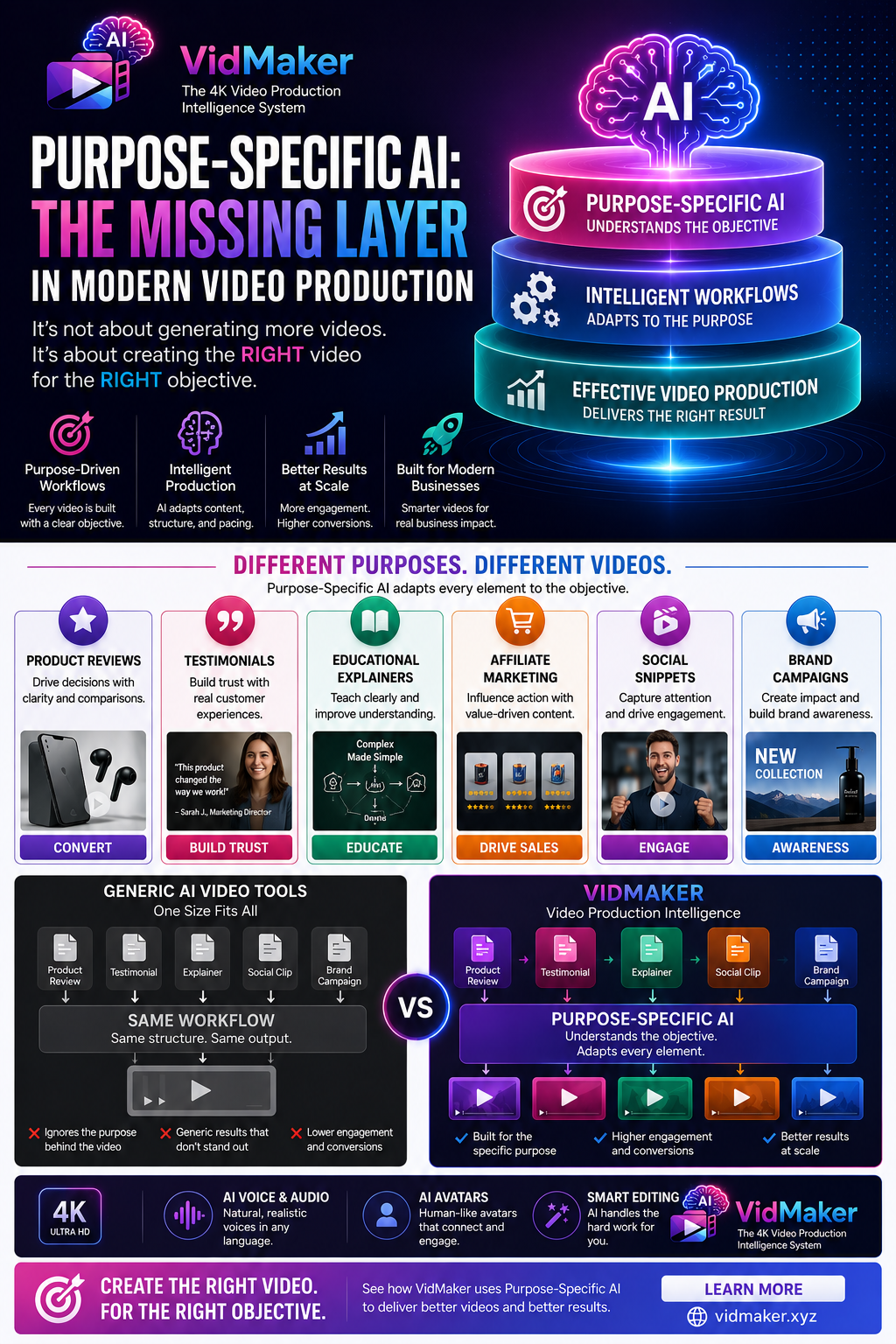
A product review video has a different objective from a testimonial video.
A testimonial video has a different objective from an educational explainer.
An educational explainer has a different objective from a brand awareness campaign.
Each requires a different structure, pacing, narrative flow, visual strategy, and production logic.
Yet many AI tools process them through the same workflow.
The result is content that may look impressive on the surface but often fails to achieve the business outcome it was created for.
Businesses don't need more videos.
They need videos that perform.
Why Different Video Types Require Different Production Logic
Imagine a company launching a new software product.
They may need:
* A product introduction video
* A customer testimonial
* An educational explainer
* Social media clips
* Comparison videos
* Affiliate marketing content
These videos serve completely different purposes.
A product introduction is designed to create awareness.
A testimonial is designed to build trust.
An explainer is designed to educate.
A comparison video is designed to assist decision-making.
An affiliate review is designed to influence purchasing behavior.
Trying to produce all of them using identical workflows often leads to generic content that struggles to connect with viewers.
The most effective video content is purpose-driven.
The production process should be as well.
## The Rise of Purpose-Specific AI
The next evolution of AI content creation is not simply larger models or faster generation.
It is specialization.
Purpose-Specific AI is built around the outcome being created rather than the content being processed.
Instead of asking:
"What content did the user provide?"
Purpose-Specific AI asks:
"What outcome is the user trying to achieve?"
That shift changes everything.
A system designed to create a testimonial video should prioritize trust, credibility, authenticity, and social proof.
A system designed to create a product review should prioritize features, benefits, demonstrations, and evaluation criteria.
A system designed to create an educational explainer should prioritize clarity, sequencing, retention, and understanding.
The intelligence behind the workflow becomes aligned with the objective of the content.
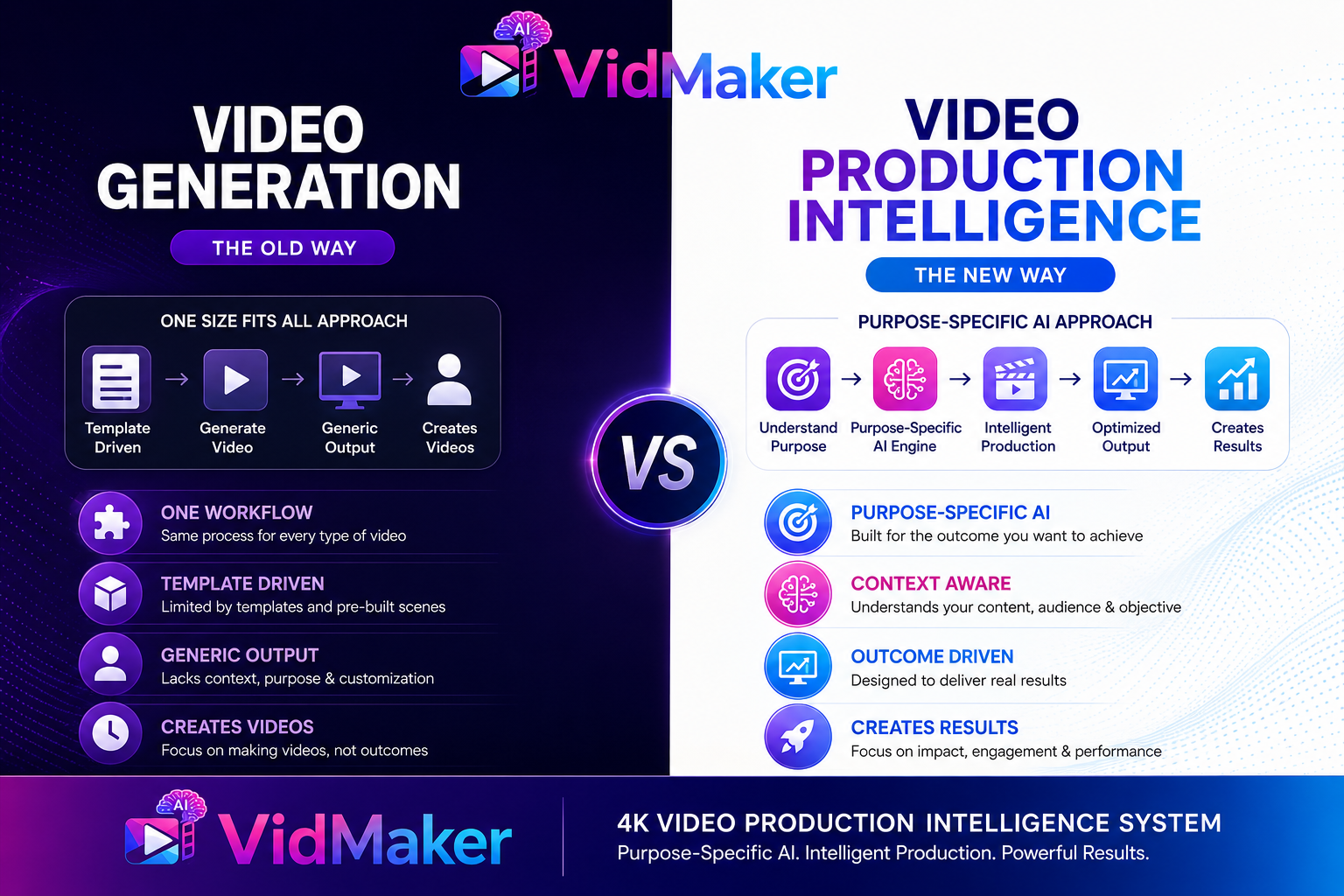
Video Generation vs Video Production
Many people use these terms interchangeably.
They shouldn't.
Video generation focuses on creating a video asset.
Video production focuses on creating a business outcome.
Video generation asks:
"Can we make a video?"
Video production asks:
"Can we make the right video for the intended goal?"
This distinction becomes increasingly important as businesses scale their content operations.
Generating hundreds of videos means very little if those videos fail to educate, convert, engage, or influence viewers.
Production is about outcomes.
Generation is about output.
The future belongs to systems that understand the difference.
Introducing Video Production Intelligence
As content demands continue to increase, businesses require more than creation tools.
They need production systems.
This is where the concept of Video Production Intelligence emerges.
Video Production Intelligence combines artificial intelligence, workflow automation, purpose-specific logic, media processing, content analysis, and platform optimization into a unified production system.
Rather than simply generating video clips, a Video Production Intelligence System analyzes the content, understands the objective, determines the most appropriate production workflow, creates scenes, generates audio, synchronizes presenters, optimizes output formats, and prepares the content for distribution.
The goal is not merely to create video.
The goal is to create results.
How VidMaker Approaches Video Production
At VidMaker, we believe the future of content creation lies beyond generic templates and one-size-fits-all workflows.
Our approach begins with understanding the purpose behind the video.
Users can start with:
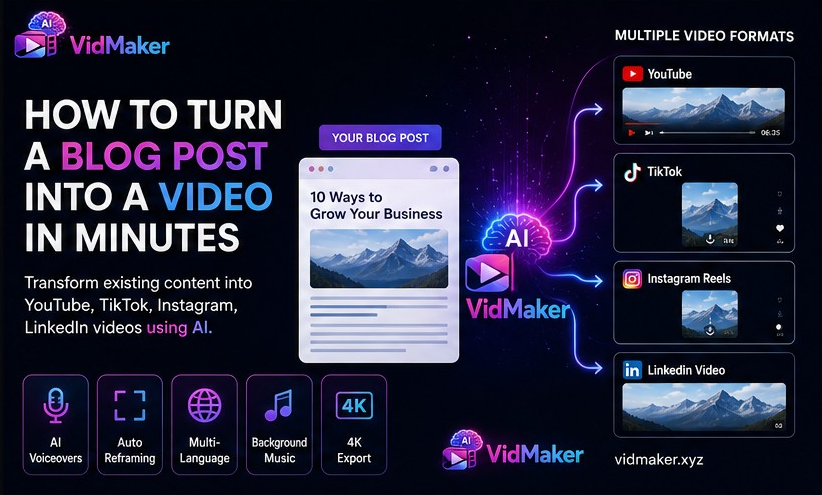
* A URL
* A blog post
* A product page
* A prompt
* Existing media
From there, purpose-specific production engines determine the appropriate workflow.
A product review follows a different production path than a testimonial.
An educational explainer follows a different path than a social snippet.
Avatar intelligence, native audio generation, motion production systems, and platform optimization work together to create videos aligned with the intended outcome.
The result is a system designed around production rather than generation.
Why This Matters For Businesses
Content expectations continue to rise.
Audiences expect high-quality video content across multiple platforms.
Marketing teams need more content.
Educators need better learning experiences.
Brands need stronger storytelling.
Creators need faster production.
Agencies need scalable workflows.
The challenge is no longer creating content.
The challenge is producing enough effective content to meet demand.
Businesses that continue relying solely on generic generation tools may find themselves struggling to scale.
Businesses that adopt intelligent production systems gain a significant competitive advantage.
The Future of Video Production
The next wave of innovation in content creation will not be defined by more templates.
It will be defined by intelligence.
Systems will become increasingly aware of context, objectives, audience behavior, platform requirements, and business outcomes.
Video creation will evolve from a creative task into an intelligent production process.
The companies that embrace this shift early will be able to produce more content, deliver better experiences, and operate with greater efficiency.
The future is not simply AI video generation.
The future is Video Production Intelligence.
Transform URLs, articles, product pages, prompts, and media into platform-ready videos using Purpose-Specific AI designed around real business outcomes.
Whether you're creating product reviews, testimonials, educational explainers, brand videos, or social snippets, VidMaker helps you produce the right video for the right objective.
Conclusion
AI video generators helped democratize content creation.
They proved that video could be produced faster and more efficiently than ever before.
But speed alone is no longer enough.
Businesses need systems that understand purpose, context, and outcomes.
They need technology capable of producing the right video for the right objective at scale.
That is the promise of Video Production Intelligence.
And it represents the next chapter in the evolution of content production. Explore Vidmaker
Video Production IntelligencePurpose-Specific AIVideo AutomationAI Video ToolsVideo MarketingBusiness Video ProductionContent ProductionMarketing AutomationVideo WorkflowsArtificial IntelligenceVidMaker
Share this article